If you read enough of what I have written, one sentence underlies all of it: encode your judgment into artifacts that outlive your attention. The artifacts change, the principle does not.
A blog post is such an artifact. A skill file is one. The principles file I keep is one. These artifacts range from trivial to deeply meaningful, and the same instinct produces all of them: I do not trust my attention to be present when it matters, so I put the judgment somewhere it can survive without me.
This is not a philosophy of throughput, though it can look like one. I am not trying to do more. I am trying to do things that keep mattering after I stop doing them. The victory condition I keep describing, in different vocabularies, is to make myself unnecessary at the layer I currently occupy, so I am free to go find the next one. That is what I am optimizing for, and once you see it, the rest follows.
The frame: the constraint always moves #
My master mental model is the Theory of Constraints, and I reach for it more than any other.
Every system has exactly one binding constraint at a time, and improving anything other than that constraint is wasted effort.
The moment you relieve the constraint, it relocates: it does not disappear, it just moves.
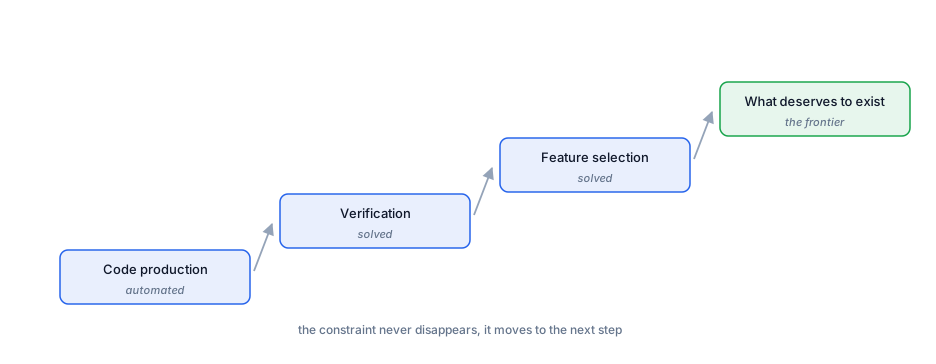
Automate code production and verification becomes the bottleneck; solve verification and feature selection becomes the bottleneck; solve feature selection and the question of what deserves to exist at all becomes the bottleneck.
The sequence I keep working through looks like this, and it never ends:
I find this frame everywhere, because it is everywhere. A team’s output is bounded by its weakest coordination path, not by how hard anyone works. A career is bounded by the skill you keep avoiding, not by the one you keep sharpening. A life is bounded by the activity you will not stop doing even though it stopped mattering years ago. The work is always the same: find the layer where the constraint currently lives, push there, and then go find it again. The people who look busy and ineffective are usually pushing somewhere the constraint is not. The people who look calm and effective have simply learned to feel where it is.
Games are one of the places I reach for when I want an analogy, because they externalize the thing I am trying to say. Factorio, StarCraft, World of Warcraft, RollerCoaster Tycoon: each is a simulation with a binding constraint, a compounding resource, and a goal that is easy to forget while you optimize a sub-goal, which is why I wrote a series mapping each onto software. The factory exists to launch the rocket, not the other way around, and every optimization that does not serve the product is wasted. Analogies are not how I think all day; they are how I explain, and sometimes how I notice a pattern I had not named yet. A trade-off that sounds abstract in software can become obvious when you see its equivalent in a game: you spent the minerals on the wrong unit, you hit the supply cap, you optimized a belt that leads nowhere.
The axis: compounding versus depreciating #
If the constraint frame tells me where to push, the compounding axis tells me what is worth pushing on at all. Every activity, skill, fix, and artifact is either compounding or depreciating. Compounding things leave future me more valuable for having done them: foundation knowledge, taste, specifications, encoded standards, durable mental models, relationships with people who grow. Depreciating things lose value as the environment moves: boilerplate, syntax, one-off patches, anything the next model release will do for free.
My decision tool is the two-year test: if I let this continue for two more years, does the me that emerges become more or less valuable? This looks like a time-management question, but it is actually an ethical one. It encodes a belief that a life is something you invest in, not something you spend.
The discipline is asymmetric, and I state it as a rule: delegate depreciating activities ruthlessly, and protect compounding activities ferociously. Protecting a depreciating activity in the name of craft is not craft; it is nostalgia, and the environment will end it. But delegating a compounding activity in the name of efficiency is not efficiency; it destroys your capability a little at a time. The number to watch is not how much I delegate; it is how much of my remaining time lands on compounding work.
The method: write everything down #
I do not trust my brain to hold anything important, because I have watched it drop too many important things. So I externalize compulsively: notes, daily questions, workstacks, process documents, this blog. Anything you keep only in your head is lost the moment you switch teams, or get tired, or get interrupted. Writing does not degrade as it passes through people; speech does, so I write decisions down.
Writing also does something the brain cannot: it makes what is implicit explicit, so it can be iterated on instead of left unrecorded. A principle in the head is a feeling that I roughly agree with; a principle on the page is a sentence I can sharpen, test against a counterexample, version, and improve. I treat my own notes and principles the way I treat code: something to refactor when it no longer holds, not something to revere because I wrote it once. An unrecorded thought cannot be revised; it can only be had again, slightly differently, next year.
And, finally, I write because I do not know what I think until I do. The first beneficiary of anything I write is me, because the act of writing is the act of finding out what I believe. A verbal decision is just an opinion that has not been replaced yet; a written decision reaches people I am not with and argues for itself without me. Writing is why the blog exists, why the principles file exists, why the daily questions exist. They are not records of conclusions I had already reached. They are how I reach those conclusions.
Then I encode. If a rule exists only in my review comments, it runs only when I am awake, looking, and willing to argue. If it is recorded in a gate, a template, a supported default, it runs always. A standard runs whether or not anyone agrees with it. An opinion stops applying the moment you go on vacation.
Verify, do not trust #
I am an empiricist by temperament, and I do not trust output; I trust the verification system behind it. A claim without an independent check is a hypothesis, not a result. Its confidence is not evidence. Once a system can produce faster than I can read it, review stops being a useful gate and becomes an empty ritual. The right approach is to push human attention upstream to specification, let machines verify compliance downstream, and operate on reality rather than prediction. A canary, a feature flag, a test that actually runs: these are more reliable than a tired human scanning a diff.
The same skepticism turns inward. I treat my own practices and opinions as hypotheses to test, not identities to defend. When I change my mind I try to do it structurally, not shamefully; the meta-process compounds while the specific answer does not. Consistently wrong is worse than inconsistently right, and the only way to avoid being consistently wrong is to keep asking what would change my mind.
Attention is the one resource I cannot manufacture #
Attention is the binding constraint of my life, so I treat it as the thing the whole system is designed to protect. Keeping up is a losing strategy; the target moves faster than any consumption can match.
The move is not to consume more but to build a funnel that throws almost everything away, confidently and without guilt. Treat urgency as something someone benefits from exaggerating. Prefer pull over push: knowing where to find something when I need it beats knowing it now. Re-audit the filter periodically, because filters are themselves depreciating assets.
Asymmetry favors the tighter filter. I would rather miss something than be overwhelmed by it, and I would rather be surprised by a concept I can reuse for a decade than briefed on ten things I will forget next week.
The moral register #
I keep this part out of most of my writing, because it does not look like the rest, but it is central. My philosophy is Stoic. The happiness of your life depends upon the quality of your thoughts. People are frugal in guarding their property but wasteful of the one thing in which it is right to be stingy, which is time. He who spares the wicked injures the good. These are not decorative quotes to me; they are the axioms the rest has to be consistent with.
From which: tolerate bad behavior and you harm the good; never discourage anyone who continually makes progress no matter how slow; a fast, clear no is a gift, not an injury; skip the blame during the incident and save it for the post-mortem; a father who can admit in writing where he failed gives his children permission to be imperfect too. I keep a register of my own failures, not as self-punishment, but because a rule without the failure that produced it is a slogan, and that failure is the part worth passing on.
I am existentialist about meaning and utilitarian about consequences, and I see no contradiction. Life does not have a meaning. You define the meaning of your life. From there, the reasonable goal is to reduce pain or increase capability for the largest population you can reach, accepting that capitalism will mostly reward you for producing work whose purpose is, in the end, about survival. I do not find this grim; I find it clarifying. It means the meaning is mine to assign and the assignment is allowed to be revised.
Set your own standard #
Do not define your identity by what the people around you do. If their standards are lower than yours and they do things you do not want to see done, that is not permission to lower yours to match. Most people drift toward the average of their environment without noticing, and the excuse is always that everyone else is doing it. The fact that someone else does something wrong does not make it right.
Be your own standard setter. Be what you would want others to be, regardless of whether they are. The standard is not a comparison to the people next to you; it is a comparison to the person you decided to be, and who you were before.
In one sentence #
Encode your judgment into artifacts that outlive your attention, from the skill file to the principles file, because that is the only move that simultaneously finds the bottleneck, compounds the foundation, protects the taste, and lets you become unnecessary at the layer you have finished building.
See also #
- Principles - the compiled list of operating rules that this article distills into a single thesis
- The Meaning of Life - the existentialist core that the moral register section rests on
- The Shifting Bottleneck - the constraint frame as it applies to software and AI
- AI-Maxxing and Resistance Are the Same Mistake - the compounding-versus-depreciating axis and the two-year test
References #
Theory of Constraints - the master mental model the frame section is built on