J. Good (1965): Informal remarks on an “intelligence explosion” through recursively self-improving (RSI) “super-intelligences”
1987: First concrete RSI: Genetic programming recursively applied to itself, to obtain meta-GP and meta-meta-GP
1997: Reinforcement learning: Lifelong meta-learning with self-modifying policies
2 agents, 2 doors, 2 keys
Through recursive self-modifications only, went from 300000 steps per trial down to 5000
A program is constructed such that it has a probability distribution over the actions/functions it should run at any time t
Some functions amongst this program are specifically designed to modify the probability distribution themselves, which will influence the future probabilistic program behavior
How can we make sure that this self-referential system learn “useful” modifications?
An algorithm is used to verify that the reward for the last [X, now] time steps has been higher than the reward for the previous [X - (now - X),X] time steps
If it is superior, then the newer program is better
If it is not, then we revert to the previous program
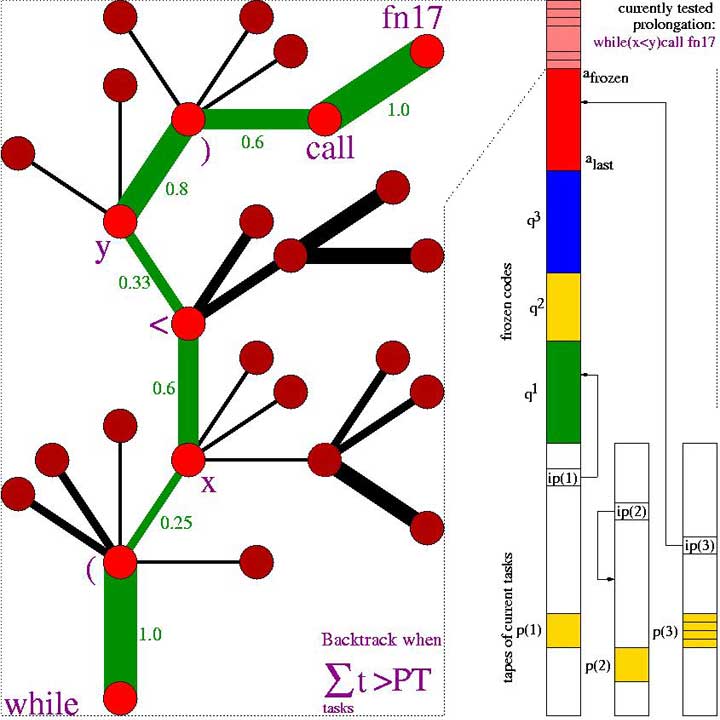
2004: Optimal Ordered Problem Solver (OOPS): Time-optimal incremental search and transfer learning in program space
Branches of search tree are program prefixes)
The fundamental deep learning problem
As you are backpropagating errors from the future to the past, the error diminishes exponentially or explodes exponentially
1991: Unsupervised pretraining for hierarchical temporal memory (stack of RNN) -> history compression -> speed up supervised learning
1997: Replaced by the long short-term memory (LSTM)
2006: Connectionist Temporal Classification (CTC)
One network which is modeling/prediction the environment while another is executing the actions