Computer programs make use of three fundamental mechanisms: elementary operations (e.g., arithmetic operations), logical flow control (branching), and external memory, which can be written to and read from in the course of computation
Modern machine learning has largely neglected the use of logical flow control and external memory
In the early 1980s, both fields considered recursive or procedural (rule-based) symbol-processing to be the highest mark of cognition
The Parallel Distributed Processing (PDP) or connectionist revolution cast aside the symbol-processing metaphor in favour of a so-called “sub-symbolic” description of thought processes
Fodor and Pylyshyn claimed that connectionist theories were incapable of variable-binding, or the assignment of a particular datum to a particular slot in a data structure
They also claimed that neural networks with fixed-length input domains could not reproduce human capabilities in tasks that involve processing variable-length structures
Their state depends on both the input to the system and on the current state
A crucial innovation to recurrent networks was the Long Short-Term Memory (LSTM)
This architecture was developed to address the “vanishing and exploding gradient” problem, which we might relabel as “vanishing and exploding sensitivity”
LSTM ameliorates the problem by embedding perfect integrators for memory storage in the network
With a mechanism that allows an enclosing network to choose when the integrator listens to inputs, we can selectively store information for an indefinite length of time
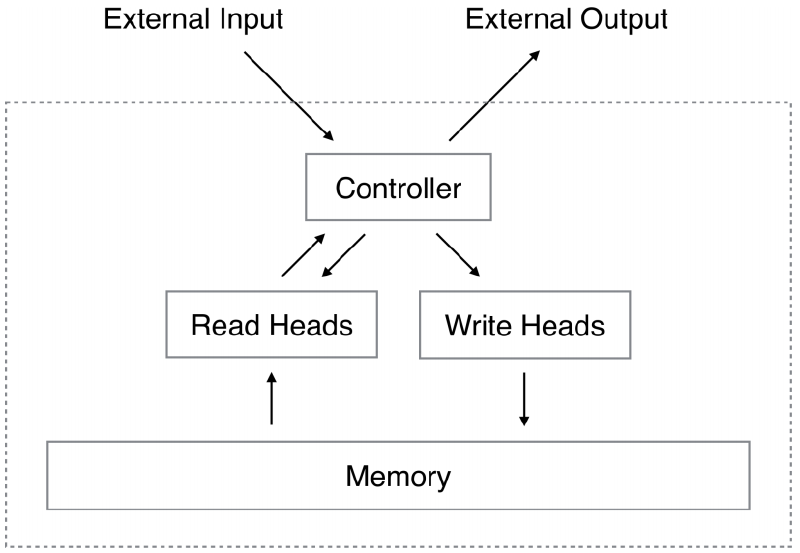
The controller interacts with the external world via input and output vectors
The controller also interacts with a memory matrix using selective read and write operations
Every component of the architecture is differentiable, making it straightforward to train with gradient descent
“Blurry” read and write operations that interact to a greater or lesser degree with all the elements in memory
The degree of blurryiness is determined by an attentional “focus” mechanism that constraints each read and write operation to interact with a small portion of the memory, while ignoring the rest
arXiv:1410.5401v2 [cs.NE]